17 Oct 2026 Notes 13 min read
Standalone: The Friday Indonesia's Stock Market Got Exiled
Understanding the issues and the impact of MSCI on the Indonesian economy
 Thoriq Faisal Yahya
Friday’s selloff exposed a problem Indonesia has spent years postponing. Investors want to know who owns the shares, whether prices reflect real trading, and whether the rules will be enforced.
On Friday, 16 October 2026, the Jakarta Composite Index (IHSG) fell 11.57% to about 5,185, its worst session since the Asian Financial Crisis. An early 8% decline triggered a 30-minute trading halt, but selling continued when the market reopened. By the end of the week, the index was down 14.91%. Market capitalization had fallen from Rp10,701 trillion to Rp9,157 trillion, a loss of Rp1,544 trillion in five trading days.
The immediate trigger was MSCI’s announcement the night before. The index provider opened a consultation on moving Indonesia from Emerging Market to Standalone Market status. Earlier warnings had raised the possibility of Frontier classification. This proposal goes further: Indonesia would leave the emerging-market benchmarks without entering MSCI’s frontier-market benchmarks.
The distinction matters because funds use those benchmarks to decide where they can invest. Indonesia has not been reclassified yet. But the possibility is serious enough to change how investors price the market today.
The selloff on 16 October
The direct losses fall on shareholders. The wider question is how a prolonged loss of confidence could affect investment, the rupiah, and public finances. To understand that risk, start with what MSCI actually announced.
What MSCI announced
On 15 October 2026 (US Eastern time; the news detonated in Jakarta on Friday morning), MSCI published a press release titled “MSCI Launches a Consultation on a Proposal to Reclassify Indonesia from Emerging Market to Standalone Market Status.” Two sentences from it matter more than everything else written about this since:
MSCI considers Indonesia’s continued classification as an Emerging Market no longer appropriate. MSCI will proceed with the proposed reclassification unless the consultation identifies clear evidence of material improvements in market governance and functioning.
Note the structure of that second sentence: this is not “we might do it.” It is “we will do it, unless you prove otherwise.” The burden of proof has flipped. Indonesia is guilty until proven reformed.
The consultation closes on 30 April 2027. MSCI will announce its decision on or before 30 June. Neither date is an announced implementation date for a downgrade.
The authorities therefore have several months to demonstrate results. Investors need to be able to see that ownership disclosures are reliable and that enforcement changes behavior. Announcing another reform package will be easier than establishing either of those things.
How the warnings escalated in 2026
This followed months of warnings. In January, MSCI raised concerns about opaque shareholding and suspected coordinated trading, and froze certain increases and additions affecting Indonesian securities. Its June review acknowledged the announced reforms but said insufficient progress by the November review could lead to a consultation, potentially on Frontier status.
By October, MSCI said market participants still had not observed sufficient progress consistently. Their feedback was that Frontier classification would not adequately reflect the problems. That is why the consultation now concerns Standalone status.
Why “Standalone” is worse than “Frontier”
A downgrade to Frontier would have been humiliating, but it comes with a perverse consolation: frontier-market funds exist, and they would have been forced buyers of Indonesian stocks entering their index. Some of the passive money leaving would have been replaced.
Standalone has no such offset. As Citi’s client note put it: “Unlike a downgrade to frontier status, a move to standalone would provide no offsetting demand from frontier-index funds, leaving passive emerging-market money heading for the exits.” There is no index fund mandated to buy Standalone markets. The money just leaves, and nobody is required to catch it.
The bank estimates cited for the proposal vary substantially. Mirae Asset Sekuritas puts passive outflows at around US$3 billion; JPMorgan estimates US$4.8 billion. The Reuters survey cited in the data notes gives a US$3–6 billion range for passive flows. UBS’s estimate of roughly US$15 billion in possible active outflows and Goldman Sachs’ US$13 billion total estimate cover different assumptions. As Mirae’s head of research put it, the proposal “goes well beyond what we had considered our worst-case scenario.”
What ‘Standalone’ costs: the exit estimates
MSCI’s concerns come down to whether investors can establish what they are buying and trade at prices they can trust. The enforcement question runs through both.
Charge one: the ownership lie
Consider a company worth Rp100 trillion that reports a public float of 15%. On paper, Rp15 trillion of shares is available to outside investors. If affiliated holders actually control 12 of those 15 percentage points, the genuinely available float could be closer to Rp3 trillion. That is an illustration of the problem, rather than a finding about a particular company.
A fund relying on the reported figure could badly overestimate how much it can buy or sell without moving the price. Disclosing more shareholder names helps only if investors can also identify connections between those holders and the controlling owner.
Indonesia’s earlier minimum free float requirement was 7.5%. The move toward 15% raises the threshold, but the transition extends into 2028 for larger companies and 2029 for smaller ones. The mid-2026 figures cited in the data notes put average free float at 23.09%, with 323 of 912 listed companies still below the new threshold. An exchange-wide average can conceal severe concentration in individual stocks.
The bar Indonesia set for itself was the lowest in Asia
On 16 October, OJK reportedly said 31 stocks on the high-concentration list showed indications of potential criminal market violations. Those indications require investigation; concentrated ownership alone does not establish a crime. They do, however, make the quality of ownership disclosure an urgent regulatory issue.
Charge two: “saham gorengan” — the national sport
Indonesian retail investors have a familiar term for speculative stocks associated with price rigging: saham gorengan, or “fried stocks.” A typical pump-and-dump scheme involves connected buyers driving up a share price, attracting outside investors, then selling into that demand. The late buyers are left exposed when the support disappears.
The criticism is that this behavior has become familiar enough to be discussed as a trading opportunity. That is troubling for anyone trying to build a market in which ordinary investors can participate with confidence. Manipulation is already prohibited in Indonesia; the issue is whether it is detected, proved, and punished effectively.
MSCI’s concern about suspected coordinated trading is closely related. If apparently independent trades come from connected parties, the price and volume may give outsiders a misleading picture of demand.
Exchange surveillance notices show how often unusual trading comes to regulators’ attention. The figures cited in the data notes include 29 Unusual Market Activity notices in the first ten trading days of January 2026. Such notices flag trading for attention; they are not findings of manipulation. BREN’s rise from its Rp780 listing price in October 2023 to Rp12,200 in May 2024, followed by a fall to Rp3,040 by September 2026, illustrates the scale of volatility investors can face. The price chart by itself cannot establish what caused those moves.
BREN share price from listing to September 2026
Retail participation makes investor protection more pressing. The cited figures put retail investors’ share of daily trading value at 38% in 2024, 50% in 2025, and 52.5% by mid-2026. That tells us who is trading, although it does not establish how losses are distributed. The investor-ID total also needs care: participation across capital-market products should not be confused with the number of people actively buying shares.
Retail investors account for a growing share of trading
Charge three: the enforcer who never showed up
MSCI acknowledged measures including disclosure of holdings above 1%, more detailed investor classifications, concentration reporting, and the free float roadmap. Its objection concerns their implementation and impact. Investors need evidence that the reforms make ownership easier to assess and trading harder to manipulate.
The administrative fines cited in the data notes total Rp105.8 billion in 2023, Rp83.3 billion in 2024, and Rp123.3 billion in 2025. Those amounts are small relative to the market, although that comparison alone cannot tell us whether enforcement works. The more useful questions are how much offenders gained, how quickly cases were resolved, and whether sanctions prevented repeat behavior.
The reported Rp2.1 trillion in sanctions announced on 16 October represents a sharp increase: Rp1.5 trillion relating to DSSA, Rp500 billion relating to BREN, and Rp100 billion relating to CUAN. Together, that is about seventeen times the 2025 total. The allegations, legal findings, and parties sanctioned need to be distinguished when assessing each case.
Reported capital market fines from 2023 to October 2026
The timing invites a reasonable question. If the conduct stretches back several years, why did action on this scale arrive only after MSCI’s announcement? Larger penalties may help, but credibility will depend on how the cases proceed and whether enforcement continues after the immediate pressure subsides.
Why this matters beyond share portfolios
A stock market selloff does not automatically become an economy-wide crisis. A prolonged loss of confidence can still make financing more expensive and put pressure on the currency. Those are the channels through which people who own no shares may feel the effects.
Lower valuations can make companies reluctant to issue new shares, especially when doing so would heavily dilute existing owners. Some investment may be delayed, though companies also have bank loans, bonds, and retained earnings available. Foreign selling can add pressure to the rupiah when investors convert sale proceeds into dollars. On 16 October, the cited JISDOR reference rate moved from Rp17,948 to Rp18,052 per dollar; the cited spot close was Rp18,027.
The rupiah moves beyond Rp18,000 per dollar
A weaker rupiah raises the local cost of imported goods and inputs. How much reaches consumers depends on hedging, subsidies, competition, and how long the depreciation lasts. If financing costs also rise and investment slows, hiring and tax receipts may weaken. These are risks that can reinforce one another, rather than a fixed sequence that must follow every market fall.
The tax record leaves little room for complacency. The fiscal figures cited in the data notes show collection exceeding its target by Rp151 trillion in 2023, then falling short by Rp57 trillion in 2024 and Rp271.7 trillion in 2025. The 2025 realization was 87.6% of target. Against that record, the 2027 target of Rp2,591 trillion, described as a 12% increase, needs a convincing explanation of where the additional revenue will come from.
Tax collection against annual targets
That policy debate extends beyond MSCI’s remit, but it raises a fair question: are public programs improving the conditions for sustained investment and work, and are their benefits worth their cost? Answering it requires evidence about the programs themselves.
The fiscal room available to respond
The 2027 budget figures cited in the data notes put spending at Rp4,106 trillion and revenue at Rp3,435 trillion. The resulting Rp671 trillion deficit is equivalent to 2.4% of GDP. Delivering that outcome depends on revenue meeting the assumptions behind the budget.
The recent record shows the risk. The cited 2025 deficit was 2.92% of GDP, close to the 3% legal ceiling, and the 2026 outlook is 2.85%. A lower planned ratio in 2027 does not by itself establish that the government has more room to absorb a shock. Revenue performance, spending commitments, and nominal GDP all matter.
Budget deficits relative to the legal ceiling
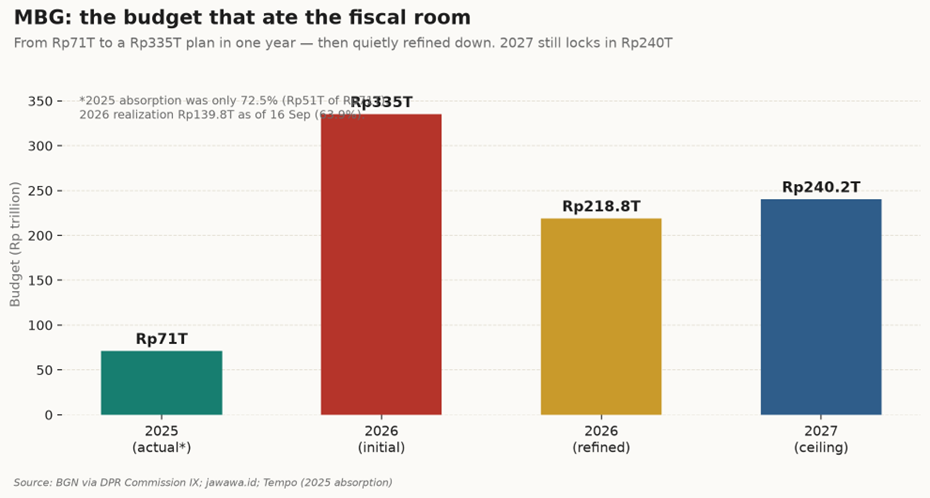
Large spending commitments deserve scrutiny in that context. The free nutritious meals program, MBG, had a Rp71 trillion budget in 2025, with reported absorption of 72.5%. The figures cited for 2026 distinguish an initial Rp335 trillion plan from a later Rp218.8 trillion allocation; the cited 2027 ceiling is Rp240 trillion. Those are different stages of budgeting, rather than directly comparable spending outcomes.
Budgets and allocations for the free nutritious meals program
The Koperasi Desa Merah Putih also involve substantial financing commitments. The cited scheme has a roughly Rp240 trillion state-bank credit ceiling and arrangements described as about Rp40 trillion in annual repayments over six years. A credit ceiling is not the same as budget expenditure. Its fiscal implications depend on actual lending, repayment obligations, and who ultimately bears losses. Both programs warrant a clear cost-benefit assessment before further commitments are made.
What would make a credible response
The immediate task is to give investors reasons to revise their assessment before MSCI’s consultation closes on 30 April 2027. Reliable beneficial-ownership information would help them distinguish shares available to the market from holdings controlled by connected parties.
The trading and enforcement response must be just as practical. Regulators should be able to investigate coordinated activity promptly, explain their findings, and apply sanctions that reflect the conduct. Investors will judge whether these steps continue once the news cycle moves on.
The wider economic response requires its own discipline. Revenue targets need defensible assumptions. Major programs need evidence of their benefits and a clear account of their costs. These issues do not determine MSCI’s classification directly, but they affect the confidence of domestic and foreign investors alike.
MSCI’s decision is due by 30 June 2027. Standalone status would be a serious setback, especially for access to benchmark-driven capital. It would not mean that Indonesia’s economy was finished. The more immediate concern is that the market problems identified this year remain unresolved, regardless of the eventual label.
Indonesia still has time to respond. Investors will be watching whether the announced reforms make a measurable difference to the way the market works.
Adapted from the video essay “Memahami masalah dan Dampak MSCI untuk perekonomian Indonesia” (https://youtu.be/hsZzNqL2yVA), with additional market and fiscal data.
Data notes: Market and fiscal figures draw on the reporting cited in the original article. IHSG, foreign flows, breadth and turnover: IDX via investor.id, Stockbit and Bisnis.com, 16–17 October 2026. Outflow estimates: Reuters analysis, 16 October 2026, citing JPMorgan, Mirae Asset and UBS; Goldman Sachs via Kontan. Free float: IDX Rule I-A and IDX release, 30 June 2026. Enforcement: OJK year-end releases for 2023–2025 and the 16 October 2026 press conference. Rupiah: BI JISDOR via Kontan. Fiscal data: Ministry of Finance and DPR Commission XI material, September 2026. MBG and cooperatives: BGN, DPR Commission IX and Ministry of Finance regulations.
MSCI sources: Reclassification consultation announcement, 15 October 2026, https://ir.msci.com/news-releases/news-release-details/msci-launches-consultation-proposal-reclassify-indonesia ; Market classification framework, https://www.msci.com/indexes/index-resources/market-classification .
Written 17 October 2026. Market data as of 16–17 October 2026.